
Best Restaurant Contact Databases for B2B Prospecting
Selling to an independent restaurant and selling to a multi-location group require different data. This guide helps suppliers and agencies choose a contact source for their actual buying task. It covers B2B prospecting, not restaurant guest CRMs or consumer mailing lists.
💡 Quick answer
For groups and purchasing relationships: evaluate Restaurantdata. For menu or technology-based targeting: evaluate Brizo by Datassential.
For territory lists: compare Outscraper’s on-demand extraction with Scrap.io’s map search and filtering. For local discovery followed by inspectable public website research: consider OwnerClue.
There is no universal winner. A store phone, a named person and a headquarters purchasing contact are different deliverables.
🧭 Find the right starting point
5 questions · optional · no email requiredOn this page
How we compared these options
We reviewed official product pages, documentation and pricing on November 1, 2026. The criteria below follow the buying task: what records you need, how you can inspect them, and what remains after collection.
OwnerClue publishes this guide and is included. This is a documentation-based comparison, not an accuracy, speed or conversion benchmark. Screenshots show actual public pages and the working CSV tool; official illustrations and sample data are identified in their captions.
| Criterion | Why it changes the choice |
|---|---|
| Buying unit | Is the record a restaurant location, an operator or headquarters? |
| Fields and evidence | Can you distinguish public business contacts from supported person-contact associations? |
| Territory and segmentation | Does it cover the city, segment and attributes driving your offer? |
| Access and cost | What do export, enrichment, users and required plans actually cost? |
| Handoff | Can you keep branch identifiers, evidence and review notes in the CRM? |
The five restaurant data options
The order follows the task, from restaurant-specific intelligence to local research. It is not a performance ranking.
1. Restaurantdata: Restaurant groups and purchasing relationships
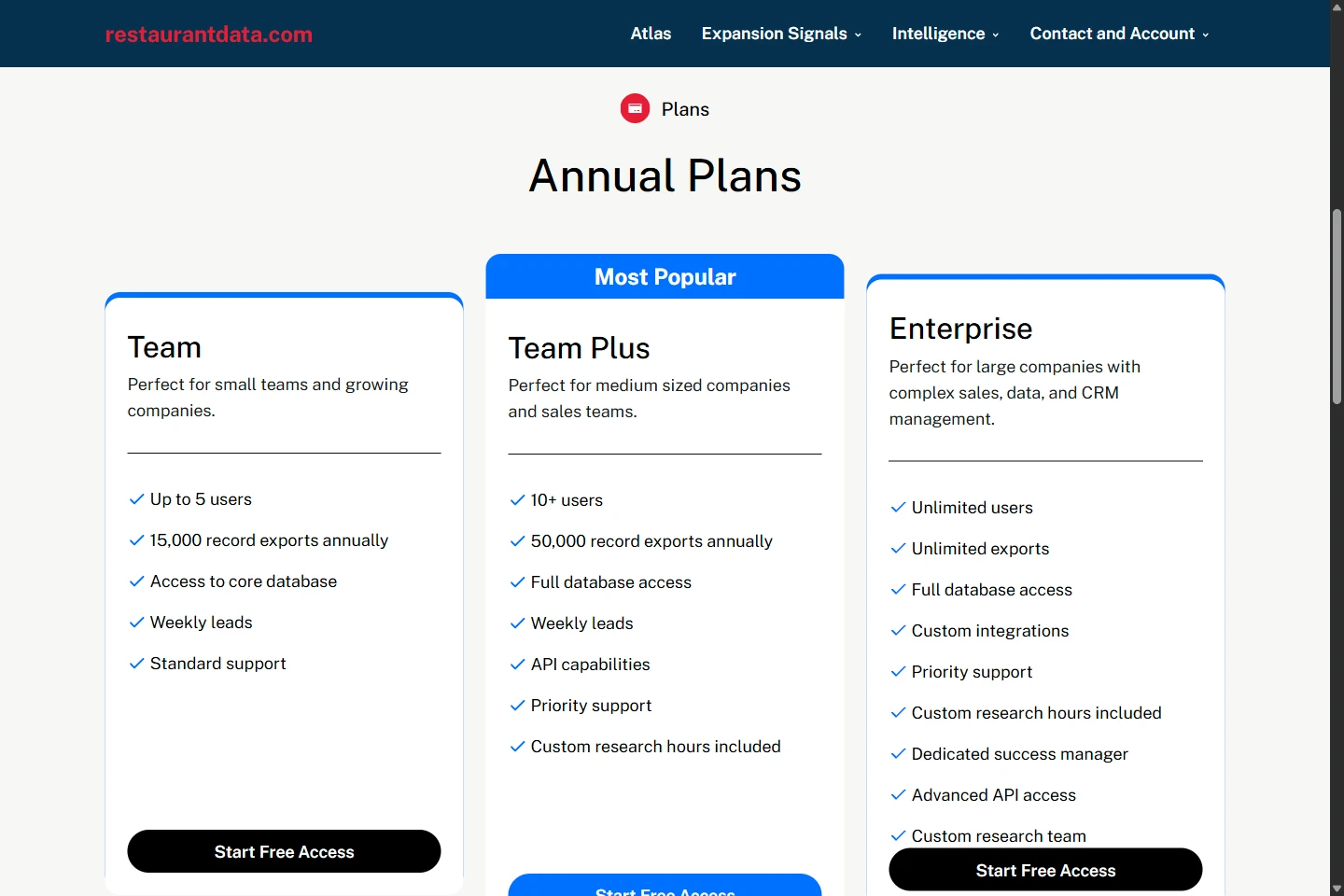
| Price | Request a quote · Annual plans; Team lists 15,000 record exports and up to 5 users. |
|---|---|
| Best for | Suppliers that must connect restaurants to an operator or headquarters. |
| Free / trial limits | Free-access invitation; confirm duration and export rights. |
| Key feature | Restaurant location-to-parent relationships and decision-maker contacts. |
| Main limitation | Owner and direct-email coverage is partial; buyer authority still needs checking. |
Core features for this task
| Account structure | Locations linked to parent organizations |
|---|---|
| Contact task | Research the role responsible for a group of stores |
| Access | Export and API entitlements differ by plan |
Why choose Restaurantdata?
Start here when the sale depends on who buys for several restaurants. A kitchen-equipment supplier approaching a franchise group needs the operating relationship as well as a store address. Ask for a sample with the location, parent organization and relevant role so you can inspect the actual buying path.
Limits to check
A store match is not a confirmed purchasing contact. The public FAQ acknowledges gaps in owner and email fields. Confirm territory coverage, role definitions and your quote before treating the dataset as a ready-to-contact account list.
Our take: A strong shortlist candidate for organizational relationships. Evaluate its sample against your buying unit, not just the number of restaurants.
2. Brizo by Datassential: Menu- and technology-based foodservice targeting
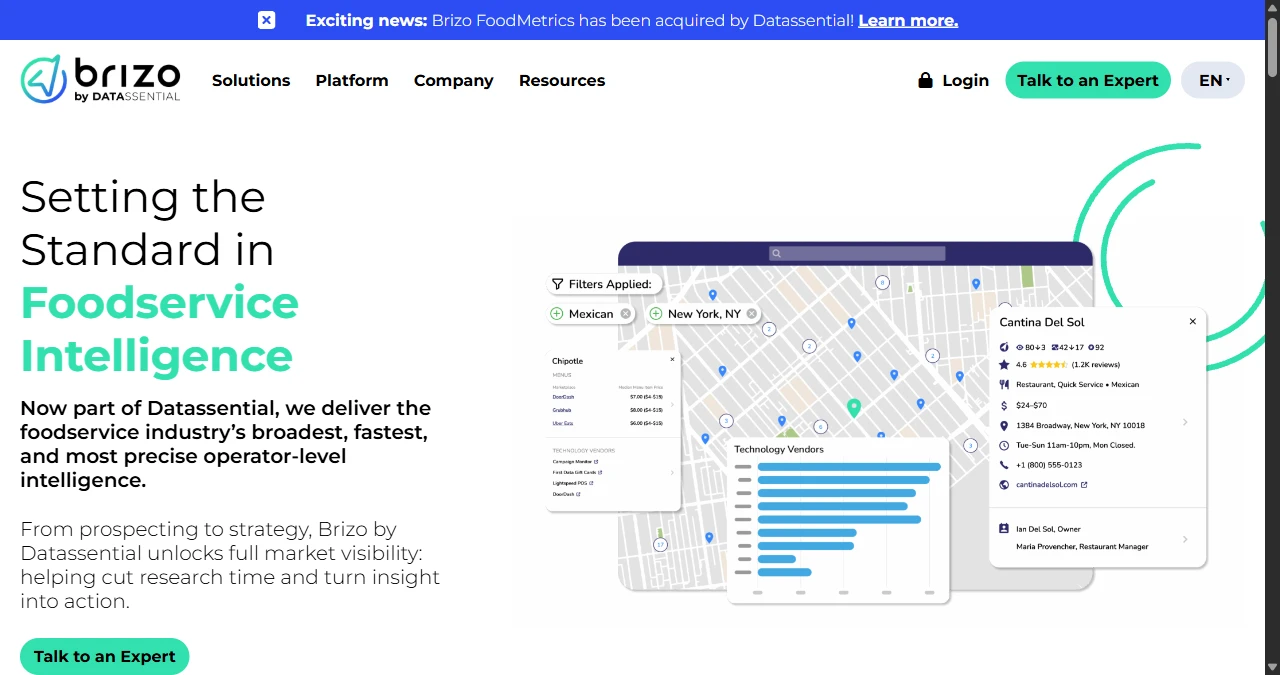
| Price | Request a quote · Confirm markets, licensed fields, exports and users with sales. |
|---|---|
| Best for | Restaurant vendors whose offer depends on menu or technology-related signals. |
| Free / trial limits | No ongoing free plan established by the reviewed overview. |
| Key feature | Foodservice operator profiles with sector-specific segmentation. |
| Main limitation | Sector intelligence does not automatically provide the named buyer or direct email. |
Core features for this task
| Segmentation | Menu and technology-related information |
|---|---|
| Audience | Foodservice suppliers and restaurant technology vendors |
| Evaluation | Demonstrate the required territory and qualifying fields |
Why choose Brizo by Datassential?
Evaluate Brizo when “restaurant in this city” is too broad. A supplier seeking a menu category or a software vendor researching an existing system needs a more specific account brief. Its current public site uses the Brizo by Datassential branding and explains the acquisition.
Limits to check
Ask how the particular field was observed and updated. A technology-related signal needs checking before you build a sales claim around it. Confirm contact depth and commercial terms separately from menu or operator coverage.
Our take: Consider it for industry-specific account selection; inspect contact coverage separately.
3. Outscraper: On-demand Maps listing exports
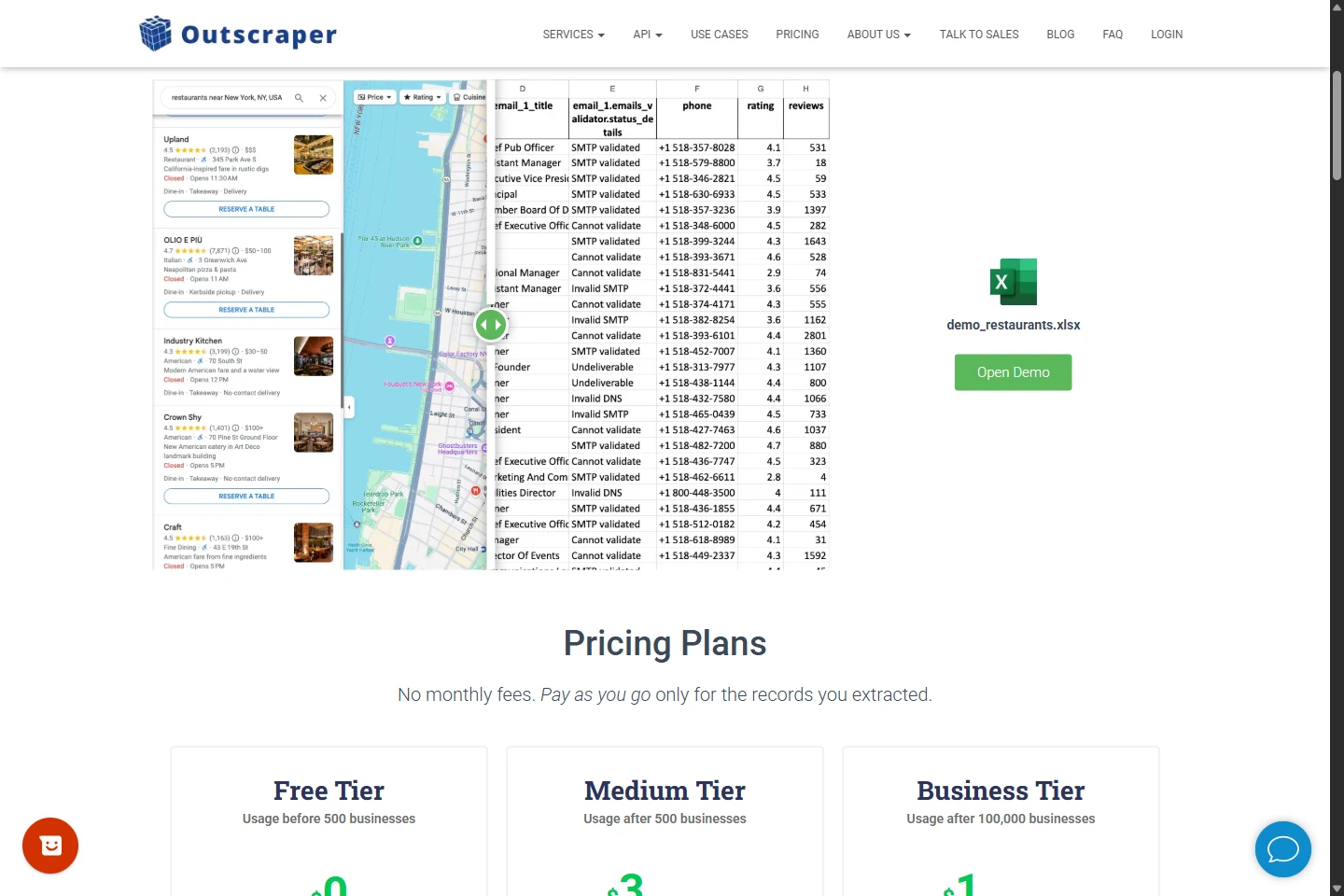
| Price | $3 / 1,000 Maps records · Published tier after 500 through 100,000 businesses; $1 / 1,000 above 100,000. Enrichments cost separately. |
|---|---|
| Best for | Teams building territory lists without maintaining their own crawler. |
| Free / trial limits | First 500 Maps businesses in the published free tier; check current billing terms. |
| Key feature | Hosted category/location extraction, file exports and optional contact enrichment. |
| Main limitation | A base Maps record is not a guaranteed owner email or approved purchasing contact. |
Core features for this task
| Discovery | Business category and location |
|---|---|
| Output | CSV, Excel, JSON and API workflows |
| Contacts | Add the contact enrichment required for your task |
Why choose Outscraper?
Consider Outscraper when the first deliverable is a restaurant territory list. You can evaluate public listing fields and a hosted collection workflow before committing to a specialist database. Its restaurant guide explains how contact enrichment extends a Maps extraction.
Limits to check
Budget the complete output: discovery, selected enrichment, matching and review. An exported phone can be a store’s general line. A newly collected source can still contain an old fact. Check the source and branch identity before accepting the row.
Our take: Useful for managed listing exports. Compare extraction plus the enrichment you need, rather than a headline per-row price.
4. Scrap.io: Map-based local business discovery and filtering
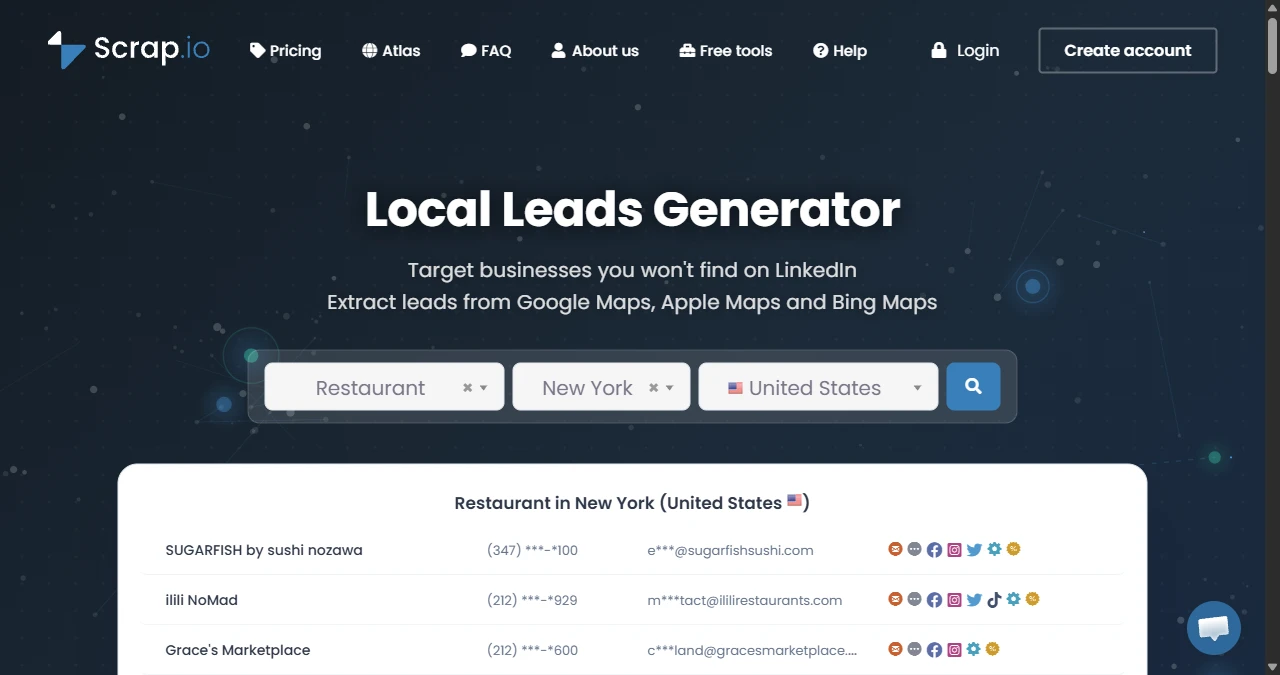
| Price | $49 / month · Basic, billed monthly, lists 10,000 monthly export credits. Geographic controls differ by plan. |
|---|---|
| Best for | Users who want local search and filters across supported map platforms. |
| Free / trial limits | 7-day trial, up to 100 leads, as advertised on the reviewed homepage. |
| Key feature | Google Maps, Apple Maps and Bing Maps discovery, file enrichment and API access. |
| Main limitation | Export credits count places; they do not guarantee personal decision-maker emails. |
Core features for this task
| Discovery | Supported map sources and business filters |
|---|---|
| Input | New searches or a file for enrichment |
| Access | Exports and API; inspect the current plan’s search limits |
Why choose Scrap.io?
Shortlist Scrap.io when map-source choice and geographic filtering matter to your prospecting process. Its public restaurant example makes the intended search/output format easy to inspect. Download a sample and compare the actual fields with your destination CRM.
Limits to check
Keep separate branches separate while flagging duplicate records for the same place. A public restaurant email may handle reservations or general questions. Inspect how any named person or verification status is established.
Our take: Evaluate it for filtered map discovery. Test your territory and export schema before buying a larger plan.
5. OwnerClue: Public-source local business and contact research
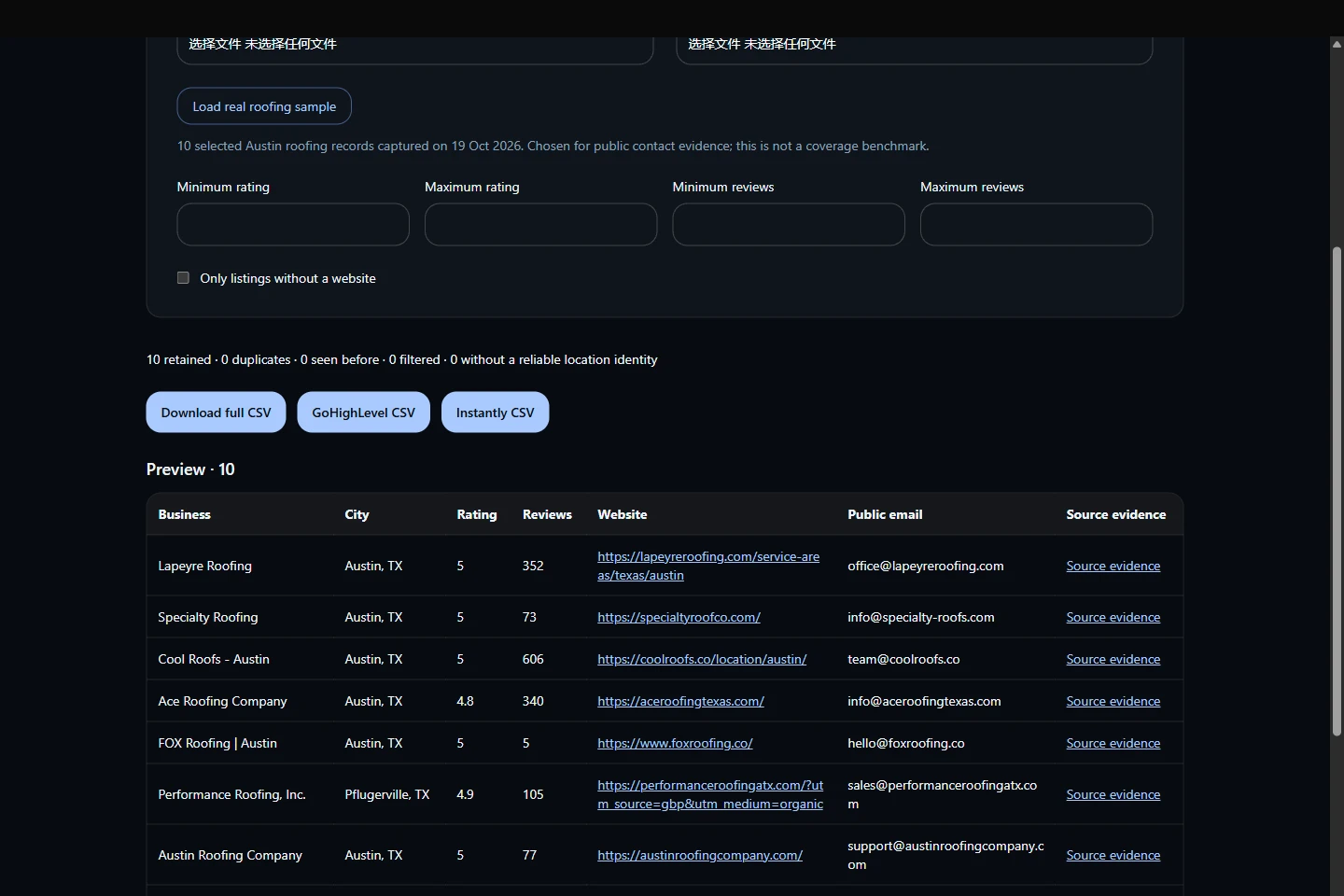
| Price | $35 / month · Starter catalog: 10,000 credits. Model actual work in the usage planner. |
|---|---|
| Best for | Local suppliers and agencies that want inspectable website-contact evidence. |
| Free / trial limits | Public CSV workbench is free; search/research access and credits are separate. |
| Key feature | Maps discovery, website contact research and explicit owner/founder evidence. |
| Main limitation | No guaranteed owner email, mailbox verification, company hierarchy or automatic sending. |
Core features for this task
| Discovery | Search supported categories and locations |
|---|---|
| Evidence | Published owner/founder role, source wording, URL and capture time |
| Existing websites | Domain enrichment followed by full CSV review |
Why choose OwnerClue?
Choose this workflow when the next task is to find local businesses and inspect the public basis for contacting them. If you already have websites, enrich those domains instead of repeating discovery. The workbench helps review records and prepare CSV handoffs.
Limits to check
A website can publish no owner information; a founder can have left the business. A general mailbox is not automatically a person’s address. The product does not guess email patterns, verify mailbox delivery, provide complete menu/technology intelligence or send outreach.
Our take: A candidate for source-backed local research. Choose a specialist provider when purchasing relationships or deeper industry attributes determine the sale.
Start a local business search →Already have the websites? Research those domains. Review source-backed fields before export; availability is not guaranteed.
Side-by-side comparison
| Requirement | Specialist restaurant intelligence | Maps listing tools | OwnerClue |
|---|---|---|---|
| Chain / franchise relationships | Evaluate Restaurantdata’s parent/location structure | Not established by a listing alone | Not a restaurant ownership hierarchy |
| Menu / technology segmentation | Evaluate Brizo against required fields | Basic category filters do not establish these attributes | No comprehensive menu or installed-software inventory |
| Find businesses in a territory | Check licensed coverage and filters | Core task for Outscraper / Scrap.io | Supported category/location search |
| Public website contact evidence | Ask about field provenance and role definitions | Check selected enrichment and sample columns | Website contact research and explicit owner/founder evidence |
| Named buyer or deliverable email | Validate coverage and verification definitions | Not guaranteed by an export | Not guaranteed; mailbox verification is separate |
The trade-offs that change the decision
Location coverage versus the organization that buys
For a service delivered to one store, the location may be the right unit. For a group contract, start with the operator and the person responsible for those locations. Do not merge stores merely because they share a brand or website.
Decision: Choose based on buying responsibility: group relationships favor a specialist dataset; location discovery favors a Maps workflow.
Contact volume versus a usable contact route
Write the minimum acceptable contact before evaluating a sample. A general phone may support a routing call. A named procurement campaign needs a supported role and current organization association. Keep unknown fields blank.
Decision: Accept the contact route that supports your next action. A larger export is not evidence of deeper buyer coverage.
Website evidence versus sector-specific intelligence
Public websites can establish services, location links and some published roles. Menu, technology and parent-company data require their own definitions and sources. Do not infer a restaurant’s installed system from one booking link.
Decision: Use public research for observable website facts; evaluate a specialist when richer foodservice segmentation is mandatory.
We use conditional recommendations rather than star scores: the reviewed evidence does not support a universal performance ranking.
Prices and free limits, side by side
USD amounts reflect public pages reviewed November 1, 2026. A monthly export credit, an extracted Maps record and a research credit are different units. Quotes, optional enrichment, extra users and independent mailbox validation can change the total. No paid extraction benchmark was run.
| Option | Published pricing / unit | Free or evaluation access | Cost to verify |
|---|---|---|---|
| Restaurantdata | Request a quote · Annual plans; Team lists 15,000 record exports and up to 5 users. | Free-access invitation; confirm duration and export rights. | Owner and direct-email coverage is partial; buyer authority still needs checking. |
| Brizo by Datassential | Request a quote · Confirm markets, licensed fields, exports and users with sales. | No ongoing free plan established by the reviewed overview. | Sector intelligence does not automatically provide the named buyer or direct email. |
| Outscraper | $3 / 1,000 Maps records · Published tier after 500 through 100,000 businesses; $1 / 1,000 above 100,000. Enrichments cost separately. | First 500 Maps businesses in the published free tier; check current billing terms. | A base Maps record is not a guaranteed owner email or approved purchasing contact. |
| Scrap.io | $49 / month · Basic, billed monthly, lists 10,000 monthly export credits. Geographic controls differ by plan. | 7-day trial, up to 100 leads, as advertised on the reviewed homepage. | Export credits count places; they do not guarantee personal decision-maker emails. |
| OwnerClue | $35 / month · Starter catalog: 10,000 credits. Model actual work in the usage planner. | Public CSV workbench is free; search/research access and credits are separate. | No guaranteed owner email, mailbox verification, company hierarchy or automatic sending. |
Cost per usable record = acquisition, required processing and review cost ÷ records meeting the acceptance rule.
Define a usable record before comparing quotes. A sample such as 20 independently checked accounts can reveal mismatched branches or missing fields; it does not establish market-wide accuracy.
Which should you choose?
You sell to a restaurant group
Start with Restaurantdata and inspect the parent-location relationship and relevant contact role. If menu or technology criteria also drive selection, evaluate Brizo separately. Ask for a target-market sample before accepting broad coverage claims.
You need restaurants in one sales territory
Compare Outscraper and Scrap.io using the same geography and required output. Include contact enrichment, duplicate review and import work. If a small hand-researched list is sufficient, a subscription may add little value.
You need evidence behind public contacts
Consider OwnerClue for website research and published owner/founder evidence. Use a specialist provider if a named purchasing role or restaurant group hierarchy is mandatory. A public source is a research input, not confirmation of buying intent.
Your first restaurant prospecting workflow
- 1. Define the account and the offer
- 2. Discover or enrich
- 3. Review and hand off
1. Define the account and the offer
Choose one supported city and restaurant segment. Decide whether you need a store, an operator or headquarters. Set mandatory fields and exclusions before collecting rows.
2. Discover or enrich
Search the category/location in the workspace, or enrich restaurant domains you already have. Review website association, published contact roles and original evidence. Keep missing fields visible.
3. Review and hand off
Retain the full CSV and source URLs. Keep distinct branches, record the review date and prepare the destination import. Research candidates still need sales qualification and any required independent contact verification.
Frequently asked questions
Which restaurant database is best for owner emails?
No option here has been independently shown to return a current owner email for every restaurant. Ask what owner means, how the email is connected to that person, and when it was observed or verified. Compare a sample from your territory.
Is there a free restaurant contact database?
Manual public-source research can suit a small list. Outscraper advertises a limited Maps allowance and Scrap.io a limited trial. These offers do not establish a permanently free restaurant decision-maker database. The free CSV workbench does not include paid research credits.
How do I evaluate a restaurant data provider?
Use a small independently checked reference set, for example 20 locations. Track correct location matches, relevant roles, usable contact routes, missing fields and review time. This proposed check is not a cross-vendor test we have already run.
Does a store manager approve a group purchase?
Not necessarily. Keep role, location responsibility and purchasing authority separate. A store manager may help route the inquiry, while an operator or headquarters approves the purchase.
🚀 Our recommendation: test the next sales task
Choose around the record you can use. If your task is local business discovery and public website contact research, evaluate OwnerClue. Keep a specialist provider or custom workflow when the required data falls outside that scope.
Start a local business search → · Enrich existing websites · Plan research usage