
7 Bright Data Alternatives for Web Scraping and Business Data (2026)
Bright Data sells several products: proxies, access APIs, scraper APIs, browsers, and datasets. A good alternative to one is not automatically an alternative to the rest. This guide focuses on collecting website and business data, with the Web Scraper API as the pricing reference.
Quick answer
For a managed scraping API, compare Oxylabs and Zyte API against the exact source and rendering mode you need. ScrapingBee fits a configurable endpoint inside a pipeline you already own.
For ready-made scrapers or custom hosted jobs, look at Apify. For crawler code you operate yourself, consider Crawlee.
For local business lists, Outscraper fits occasional Maps exports; OwnerClue fits agency research with website observations and sourced contacts. They do not replace a general proxy network or browser API.
Keep Bright Data when its maintained scraper, delivery format, or wider infrastructure already meets the requirement. Its Web Scraper API also lists a 5,000-record monthly free tier.
Which Bright Data alternative fits your task?
3 quick questions · optionalHow we compared these alternatives
We checked official product pages, documentation, and pricing for the work each tool can take over, the cost to start, free or trial limits, and what you would need to rebuild. Prices were checked on October 12, 2026.
OwnerClue publishes this guide and is included below. This is a documentation-based comparison, not a performance benchmark. Website captures identify products and plan terms; official demonstrations and the redacted workspace are labeled in their captions.
| What we compared | Why it matters |
|---|---|
| Product and output | Proxies, page content, parsed records, and pre-collected datasets are different deliverables. |
| Exact target and fields | A maintained source scraper and a custom-domain request can have different schemas and rates. |
| Rendering and parsing | JavaScript, interaction, extraction options, and target tiers change usable-output cost. |
| Pipeline ownership | Someone still needs to own discovery, scheduling, field mapping, and missing-data monitoring. |
On this page
Why look for alternatives to Bright Data?
Start by naming the Bright Data product you want to replace. A proxy carries traffic; a retrieval API returns page content; a maintained scraper returns structured fields; a dataset supplies an existing collection. Those outputs carry different costs and responsibilities.
A supported-source scraper is the closest comparison when your application expects a stable product, profile, or listing schema. Check the specific fields, source variants, freshness, and delivery method. A cheaper HTML response is not equivalent if your team has to maintain the parsing.
A retrieval service is relevant when you already control the URL queue and extraction code. Compare JavaScript support, request settings, response formats, and how optional extraction changes the bill.
A business-research tool is a narrower option when the end goal is a reviewed local prospect list. It can remove some assembly work for that job, while leaving broader collection infrastructure untouched. Do not migrate a price-monitoring pipeline or a custom browser workflow into a tool built for local leads.
The 7 Bright Data alternatives
These tools take over different parts of the job. Each uses the same quick-fact format, followed by a practical use case and a limitation that could change your choice.
1. Oxylabs: a managed scraping API
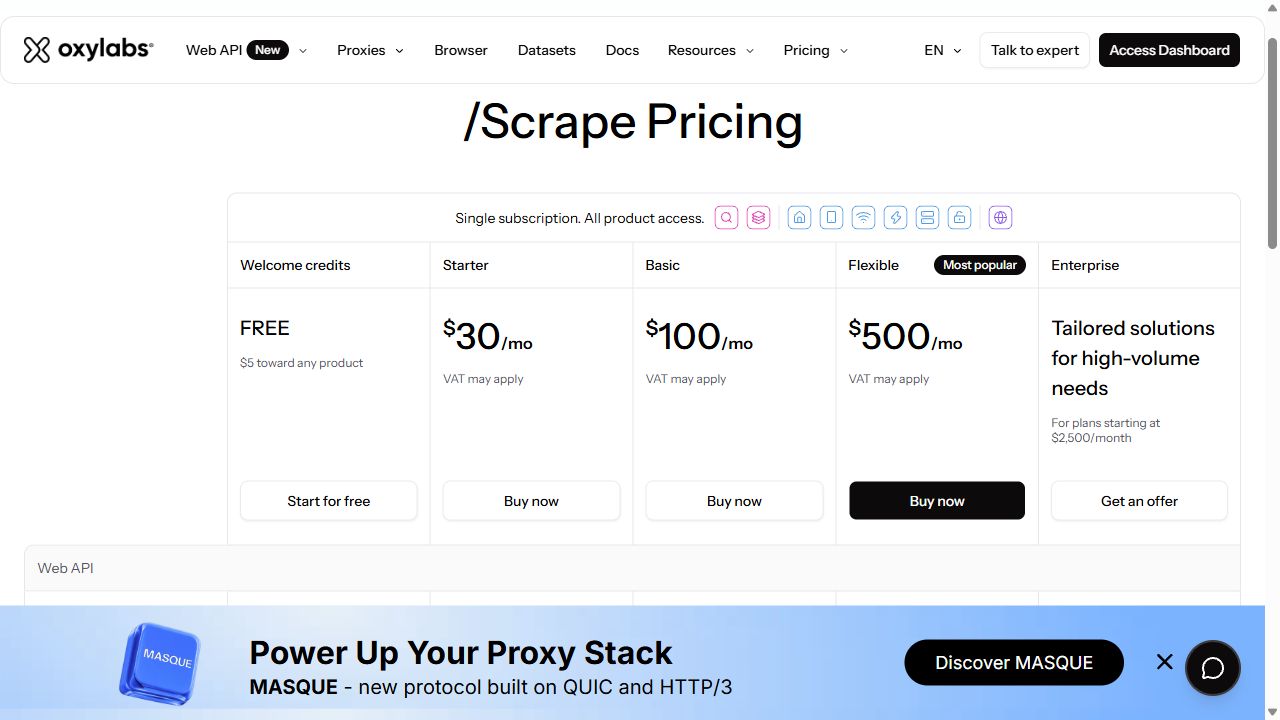
| Price | Starter $30 / monthCurrent Web API /Scrape subscription. Custom domains: $1 / 1,000 non-JS or $1.50 / 1,000 JS results at Starter rates |
|---|---|
| Best for | Developers who need managed retrieval and source-specific scraping endpoints. |
| Free / trial limits | $5 welcome credits toward products · not a recurring allowance |
| Key feature | Web API /Scrape with target-specific retrieval and parsing options. |
| Main limitation | Source, rendering, and AI parsing change the rate; the lowest advertised rate is not a universal price. |
Oxylabs is a relevant direct candidate for the managed scraping part of Bright Data. Its former Web Scraper API pricing URL now redirects to Web API /Scrape, with a shared subscription and target-specific rates.
For a custom domain, the Starter table lists separate JavaScript and non-JavaScript rates. Amazon, Google, and other targets have their own rows, and AI parsing is priced separately.
Compare the endpoint and returned schema that your pipeline actually needs. Do not use the lowest Amazon rate to estimate a browser-rendered custom site. A trial should include your difficult pages as well as your easy ones.
A close candidate for API-led collection. Price the exact source, rendering mode, and parsing configuration.
2. Zyte API: usage-based website retrieval
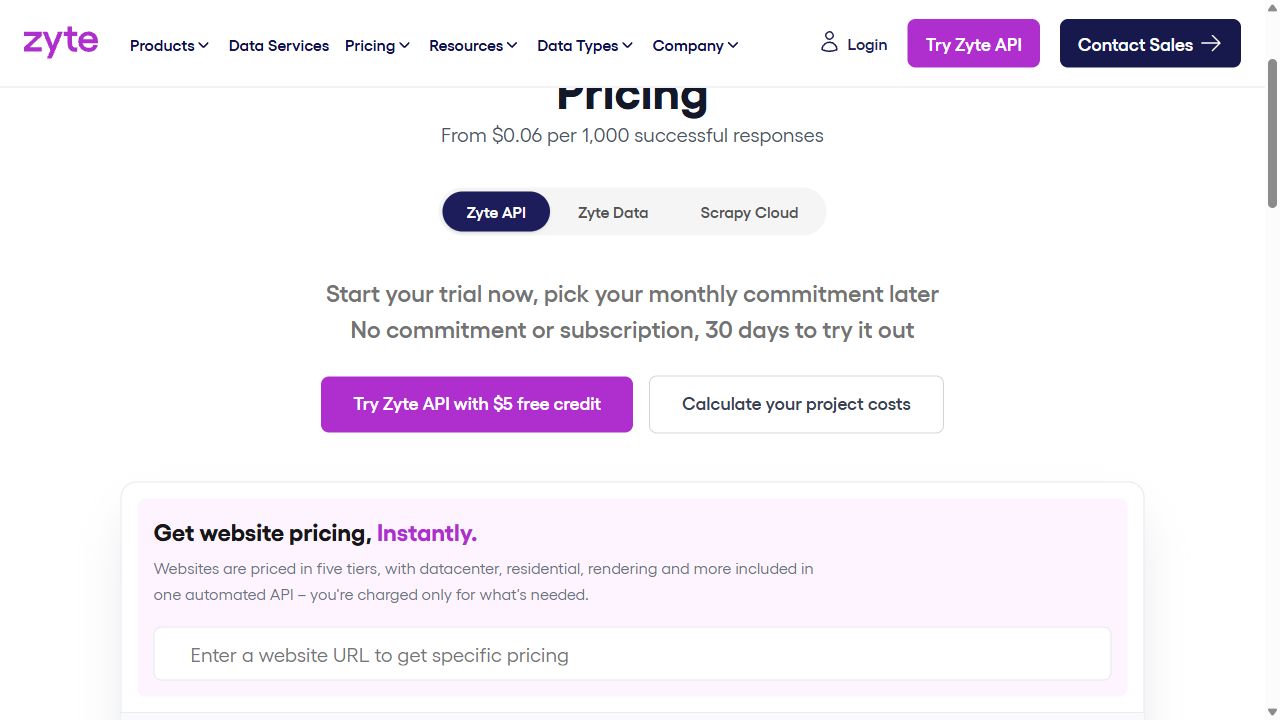
| Price | PAYG HTTP $0.13–$1.27 / 1,000Browser-rendered PAYG $1.01–$16.08 / 1,000; site tier and extra features affect cost |
|---|---|
| Best for | Developers who want managed access while retaining their crawling pipeline. |
| Free / trial limits | $5 credit · 30-day evaluation |
| Key feature | Managed retrieval and browser rendering with automatic extraction options. |
| Main limitation | HTTP, browser, and extraction costs differ; the headline minimum assumes a commitment. |
Zyte API is useful when you want to keep the URL queue and downstream pipeline but move retrieval and rendering to a managed service. Its HTTP and browser requests have different prices, and the target website determines the tier.
That matters for a mixed crawl: an easy static article and a difficult rendered product page should not receive the same cost estimate. Automatic extraction and other options can add charges.
The pricing page’s lowest headline rate belongs to a committed plan. The table here uses pay-as-you-go ranges so the comparison does not assume a monthly commitment you have not chosen.
Consider it for a pipeline your developers already control. Estimate costs with representative URLs and the same extraction settings.
3. ScrapingBee: a configurable scraping endpoint
| Price | Freelance $49 / month250,000 API credits and 50 concurrent requests currently listed |
|---|---|
| Best for | Developers fetching pages and extracting selected fields in an existing application. |
| Free / trial limits | 1,000 trial API credits · no card required |
| Key feature | Page retrieval, JavaScript scenarios, and CSS/XPath or AI extraction. |
| Main limitation | One request can use several credits depending on rendering, proxy, and extraction options. |
ScrapingBee suits a developer who wants to request a URL and choose how it is fetched or extracted. Its documented options include JavaScript interactions, selector-based extraction, and AI extraction.
For a price tracker, start with the simplest configuration that returns the required fields. Add rendering or interaction only when the source requires it, and check the resulting credits per successful page.
The current Freelance card lists 250,000 credits. That is a credit budget, not a promise of 250,000 rendered pages or complete product records. Your application still needs to schedule requests, map outputs, and monitor missing fields.
A practical endpoint for a pipeline you own. Compare credits per usable output, not advertised credits alone.
4. Apify: ready-made scrapers and custom cloud jobs
| Price | Starter $19 / month + usage$19 prepaid usage; Actor and platform charges draw from that allowance |
|---|---|
| Best for | Teams combining supported scrapers with APIs, schedules, or custom code. |
| Free / trial limits | $5 of usage each month · no card required |
| Key feature | An Actor marketplace and hosted runtime for extraction and automation. |
| Main limitation | Actor inputs, outputs, prices, and maintenance differ by developer. |
Apify is a useful candidate when a ready-made Actor covers your source or when you need custom logic around collection. Its hosted runtime, schedules, datasets, and APIs suit a multi-step job with more than one extraction step.
For a retailer tracking a defined set of product URLs, inspect the selected Actor’s price, availability, identifiers, and timestamps. Two Actors for the same site can differ in fields, maintenance, and billing.
This is a platform-and-Actor decision rather than a direct proxy replacement. Include the Actor’s event or usage charges and any additional platform consumption. Run a small sample before estimating the monthly pipeline cost.
Choose it when a verified Actor or custom hosted program is the deciding factor. Compare its complete output and billing with the current Bright Data scraper.
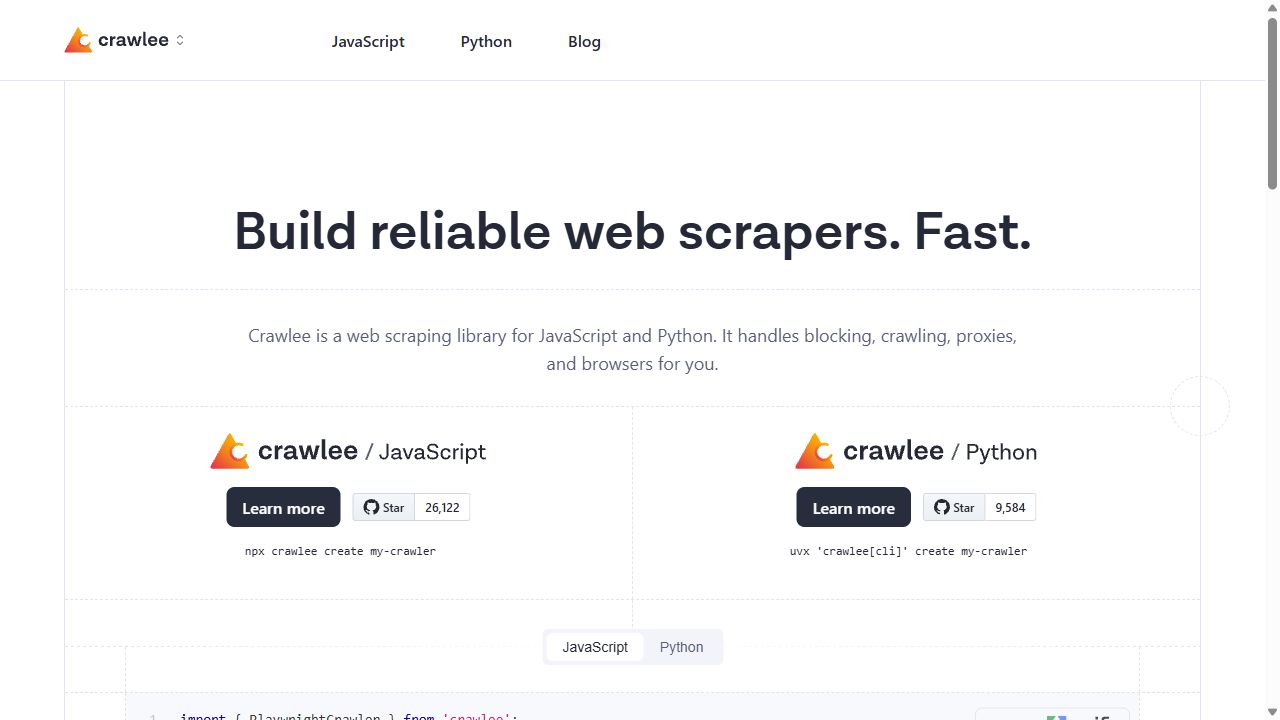
5. Crawlee: a crawler your team owns
| Price | Free, open-source softwareHosting, proxies, storage, and engineering are additional costs |
|---|---|
| Best for | Developers who will build and operate their own extraction code. |
| Free / trial limits | Library has no software subscription fee |
| Key feature | Open-source JavaScript and Python crawling, with infrastructure you manage. |
| Main limitation | Your team owns execution, monitoring, infrastructure, and maintenance. |
Crawlee is the option when control over extraction code matters more than buying a maintained data service. It is an open-source crawling library from Apify, with JavaScript and Python entry points.
For a team collecting a changing set of internal research sources, owning the request queue and parsing code can be useful. But that team also owns execution, storage, schedules, monitoring, and maintenance when a site changes.
Crawlee does not include a proxy network or a ready-made replacement for Bright Data’s source schemas. You may still use a managed retrieval or proxy service underneath it. Budget the infrastructure and engineering before treating the absence of a software fee as a lower total cost.
Consider it when your team can operate the crawler. It is an infrastructure choice, not a free equivalent of a managed data feed.
6. Outscraper: occasional Google Maps exports
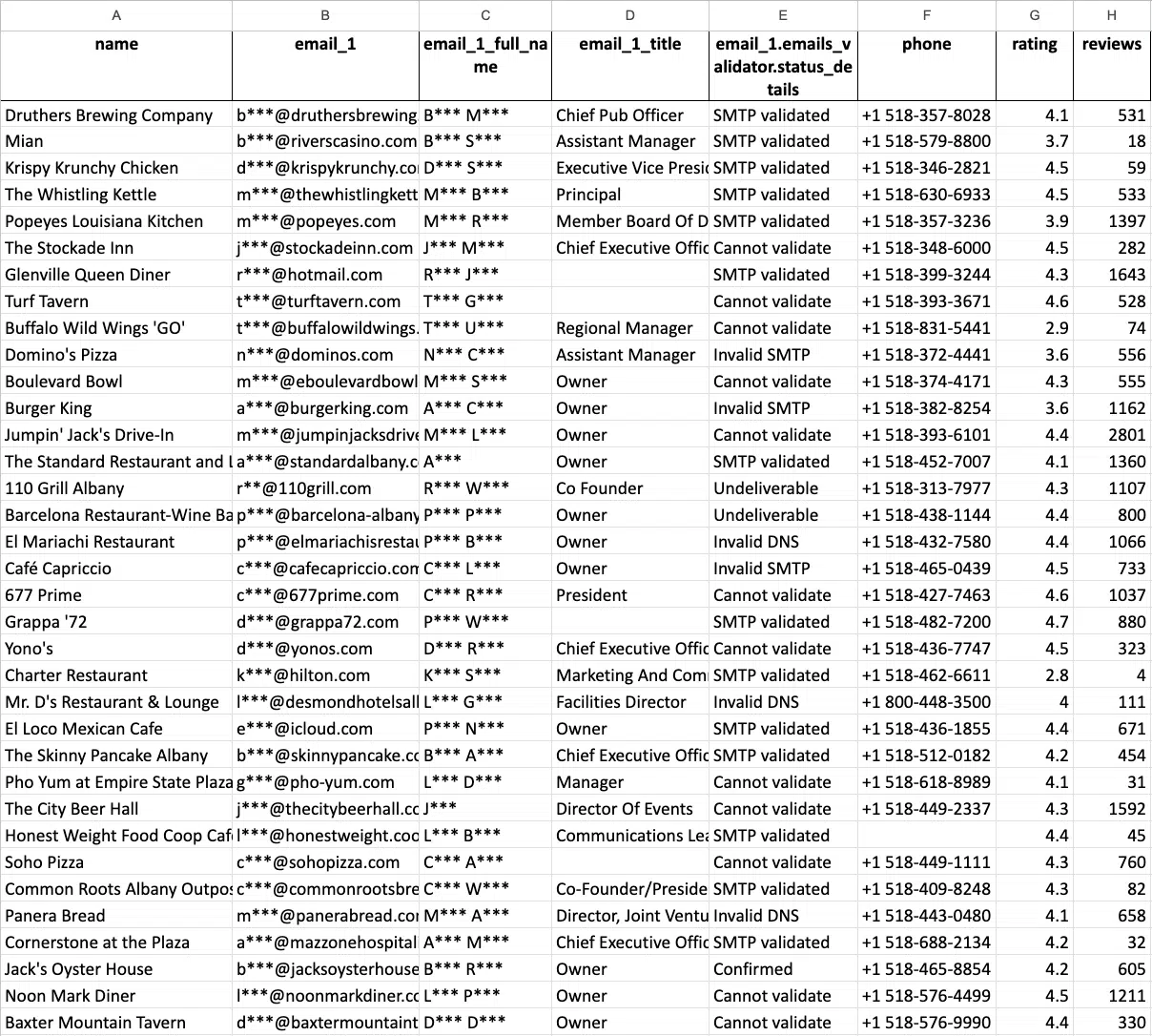
| Price | $3 / 1,000 Maps recordsUsage from 501 to 100,000 businesses; then $1 / 1,000 above that tier |
|---|---|
| Best for | Teams that want Maps records without a recurring subscription. |
| Free / trial limits | First 500 Maps businesses; tiers reset every 30 days |
| Key feature | Google Maps business exports with optional website-contact enrichment. |
| Main limitation | Base Maps extraction and additional enrichment need separate budgeting. |
Outscraper is a specialist option when the Bright Data job you need to replace is a Google Maps business export. It returns listing fields and offers separate services for website-contact enrichment.
For an occasional territory list, usage-based extraction can be easier to budget than maintaining a custom collection pipeline. Check the same locations, listing fields, and duplicates before changing the source.
The base Maps price does not include every enrichment you might need. Compare extraction plus contact research, and preserve the listing identifiers for later joins. This option does not replace Bright Data’s general website APIs, browsers, or proxy infrastructure.
A focused candidate for a Maps list. Match the required fields and enrichment services before comparing the per-record price.
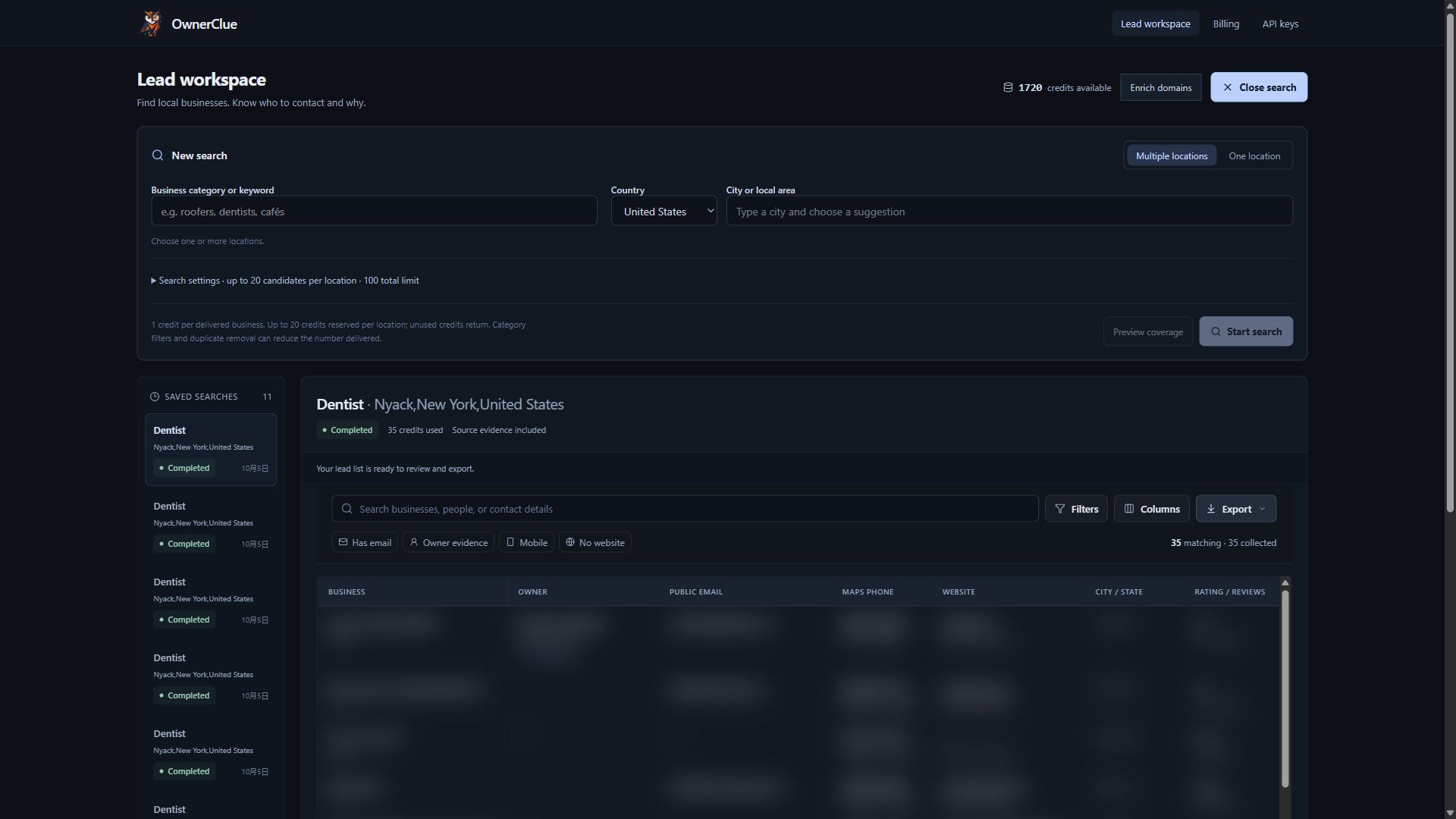
7. OwnerClue: local agency prospect research
| Price | Starter $35 / month10,000 credits shared across supported operations |
|---|---|
| Best for | Web design, local SEO, and marketing agencies researching local prospects. |
| Free / trial limits | One-time 20-credit trial · 14 days · no card required |
| Key feature | Local market search, website research, opportunity clues, and sourced contacts in one prospecting workspace. |
| Main limitation | Public contacts and owners can be missing. Mailbox-delivery verification is separate. |
OwnerClue fits the agency job after deciding which local market to research. It combines industry-and-location discovery, website observations, sourced contact review, and CSV export around a business record.
For an SEO or web design agency, the useful output is a shortlist with context: the listed website, what could be inspected, available contact routes, and supported owner/founder evidence. This can reduce the need to assemble the research across separate files. No listed website or no booking link found is a clue to investigate, not proof of demand.
Bright Data can already collect business records. OwnerClue’s reason to be here is the agency research workflow, not exclusive access to that data. It does not replace arbitrary-source APIs, proxies, or browser automation. Contacts can be missing, and CSV handoffs do not provide native CRM sync or mailbox-delivery verification.
Consider it when the end product is an agency prospect shortlist. Keep an API provider when your application needs general web-data collection.
Prices and free limits, side by side
USD figures distinguish monthly billing, annual equivalents, and usage-based charges. Free plans and evaluation offers appear separately in each row.
| Tool | Free / trial access | Paid starting point | Key feature |
|---|---|---|---|
| Bright Data | 5,000 records / month listed for the Web Scraper API | $1.50 / 1,000 recordsWeb Scraper API pay-as-you-go pricing | Maintained scraper APIs with structured JSON, NDJSON, or CSV delivery. |
| Oxylabs | $5 welcome credits toward products · not a recurring allowance | Starter $30 / monthCurrent Web API /Scrape subscription. Custom domains: $1 / 1,000 non-JS or $1.50 / 1,000 JS results at Starter rates | Web API /Scrape with target-specific retrieval and parsing options. |
| Zyte API | $5 credit · 30-day evaluation | PAYG HTTP $0.13–$1.27 / 1,000Browser-rendered PAYG $1.01–$16.08 / 1,000; site tier and extra features affect cost | Managed retrieval and browser rendering with automatic extraction options. |
| ScrapingBee | 1,000 trial API credits · no card required | Freelance $49 / month250,000 API credits and 50 concurrent requests currently listed | Page retrieval, JavaScript scenarios, and CSS/XPath or AI extraction. |
| Apify | $5 of usage each month · no card required | Starter $19 / month + usage$19 prepaid usage; Actor and platform charges draw from that allowance | An Actor marketplace and hosted runtime for extraction and automation. |
| Crawlee | Library has no software subscription fee | Free, open-source softwareHosting, proxies, storage, and engineering are additional costs | Open-source JavaScript and Python crawling, with infrastructure you manage. |
| Outscraper | First 500 Maps businesses; tiers reset every 30 days | $3 / 1,000 Maps recordsUsage from 501 to 100,000 businesses; then $1 / 1,000 above that tier | Google Maps business exports with optional website-contact enrichment. |
| OwnerClue | One-time 20-credit trial · 14 days · no card required | Starter $35 / month10,000 credits shared across supported operations | Local market search, website research, opportunity clues, and sourced contacts in one prospecting workspace. |
Official sources are linked under each product. The publisher’s trial is one-time. Credit, page, URL, seat, and record allowances measure different things; confirm the selected configuration before purchasing.
Price the output your application can use. Bright Data’s Web Scraper API lists $1.50 per 1,000 delivered records on pay-as-you-go. The five-thousand-record free tier belongs to that product; proxy, browser, and dataset offers have their own terms.
The alternatives use different units. Zyte prices HTTP and browser requests by site tier. ScrapingBee sells credits that settings can multiply. Oxylabs prices by target and configuration, with separate AI parsing rates. An Apify Actor can charge by event or platform usage. These are not interchangeable rows of “records.”
Use a representative sample containing the page layouts and rendering requirements that make the real job difficult. Count only outputs with the required fields, then add parsing, enrichment, storage, and operating work that the replacement leaves to you. Keep the same acceptance criteria on both sides.
Cost per usable record = total collection and processing cost ÷ records meeting the brief
How to replace your Bright Data workflow
The safest pilot replaces one source or one research job first. Leave other Bright Data services in place until their replacement is demonstrated.
| Current output | Replacement path | Pilot check | Work you still own |
|---|---|---|---|
| Structured source records | Oxylabs, Zyte extraction, or an Apify Actor | Same URLs, required fields, identifiers, rendering, and freshness | Schema mapping, delivery handoff, missing-field checks |
| Page content for your parser | Zyte API, ScrapingBee, or Crawlee + retrieval | HTML/rendered output and successful fetch cost | URL discovery, parsing, schedules, and monitoring |
| Local prospect shortlist | Outscraper or OwnerClue | Same trade/territory and required contact context | Review, exclusions, CSV import, and any sending workflow |
1. Replace one maintained scraper
Freeze a sample of source URLs and required output fields. Run the candidate with equivalent rendering and extraction settings. Compare identifiers, variants, timestamps, missing values, and delivered-record counts. Adapt the API or webhook handoff, then run one scheduled cycle before routing the remaining volume to it.
2. Change retrieval without changing the whole pipeline
Keep your discovery queue and downstream parser. Replace the request layer for a small URL set and inspect the returned content before parsing. Confirm which responses are charged and which options add costs. Recreate retry and monitoring behavior in your application where needed. A retrieval endpoint is not a complete scheduler or data-quality system.
3. Simplify a local-business research job
Define the trade, territory, and contact fields you actually need. Compare a Maps export through Outscraper with an agency research shortlist in OwnerClue. Inspect website associations and contact sources, retain the original identifiers, and export the accepted businesses. Keep Bright Data for unrelated product, social, or custom-source collection.
- Define required fields
- Run matched source URLs
- Map and inspect output
- Move one scheduled source
Which alternative should you choose?
For a developer buying managed extraction
Compare Oxylabs against the exact source endpoint and parsing needs. Compare Zyte when target-tiered retrieval fits your existing pipeline. Choose ScrapingBee when configurable fetching and extraction parameters suit the application. Select from the actual sample results and cost rather than the lowest published rate.
For a team that wants more code control
Use Apify for a verified Actor or custom hosted program. Choose Crawlee when operating the code and infrastructure is a deliberate team decision. You can combine a crawler library with managed retrieval; these tools are not mutually exclusive.
For an agency preparing local sales lists
Choose Outscraper for occasional listing exports, or consider OwnerClue for a shortlist that includes website observations and sourced contact review. These replace a business-research job. They are poor choices when the requirement is arbitrary-source extraction, remote browser execution, or a general proxy service.
When to keep Bright Data
Keep Bright Data if its maintained scraper already returns the fields your application needs and the delivery integration is stable. Its record-based pricing may also be simpler for that job than operating your own parser around a cheaper retrieval endpoint.
If you use several Bright Data products, compare them separately. A successful scraper migration does not establish that you should move proxies, browsers, or purchased datasets. For a small supported-source job, check the monthly Web Scraper API free tier before paying for a replacement.
Frequently asked questions
Which is the closest Bright Data alternative?
For managed extraction, start with Oxylabs or Zyte API and compare the exact source and output. For a configurable endpoint, consider ScrapingBee. This guide does not claim one tool replaces the entire Bright Data proxy, browser, scraper, and dataset offering.
Is there a free alternative to Bright Data?
Crawlee has no software fee, but operating it is not free. Apify has $5 of monthly usage and Outscraper has a limited Maps free tier. Bright Data itself lists 5,000 Web Scraper API records per month free. Trial credits from API providers should not be counted as recurring access.
Why can a cheaper request still produce a more expensive record?
The replacement may return HTML instead of parsed fields, require several requests for one record, or consume extra credits for rendering and extraction. Missing fields can also create cleanup work. Compare total job cost with the number of accepted outputs under the same criteria.
Can I keep Bright Data and add a separate research tool?
Yes. Keep the collection step that works, then test a separate enrichment or review step against exported domains. OwnerClue accepts up to 100 domain rows per batch. Join reviewed results by domain and preserve sources. This is a file handoff, not a native replacement for the existing API pipeline.
Does OwnerClue replace a proxy or browser API?
No. It is for local business discovery and agency website/contact research. It does not offer a general proxy network, arbitrary-source scraper, or remote browser runtime. Use the API-focused candidates for those infrastructure jobs.
Test the workflow before you switch
Replace the product and output you actually use. Start with one source, match the fields and rendering settings, then compare usable-record cost and the operating work left to your team.
If local agency prospect research is your priority, try a small list in OwnerClue. The one-time trial includes 20 credits, valid for 14 days, with no card required.